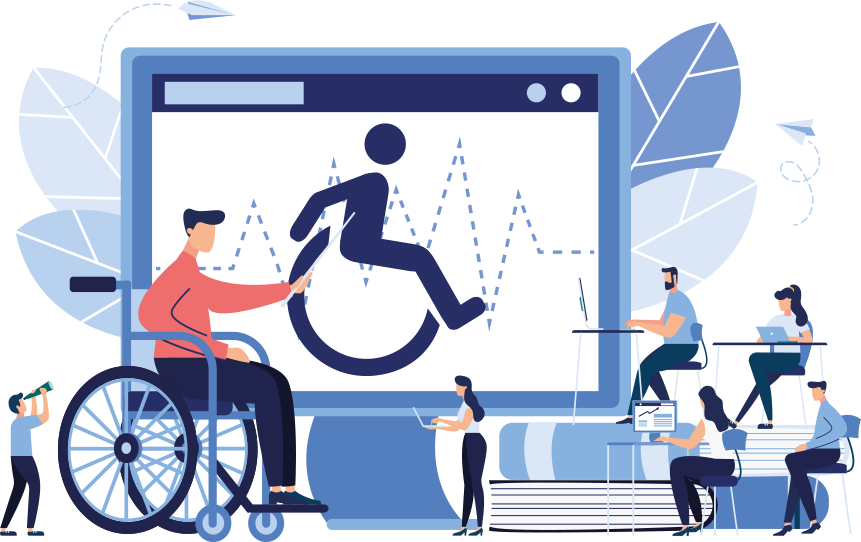

What is The ADA (Americans with Disabilities Act)?
The Americans with Disabilities Act of 1990 is a civil rights law for the general public that prohibits discrimination against individuals with disabilities in all public living areas, including schools, transportation, jobs, state and local government services, telecommunications.
What is WCAG (Website Content Accessibility Guidelines) 2.1?
The Web Content Accessibility Guidelines (WCAG) establish guidelines for making Web content more accessible to individuals with disabilities.
Visual, auditory, physical, motor, cognitive, language, learning, and neurological disorders all fall under the umbrella of accessibility.
WCAG standards are established by the World Wide Web Consortium (W3C) composed of nonprofits, corporations, and educational institutions that work towards establishing the standards by which the Internet is governed. WCAG Guidelines are simply that, guidelines, or standards which are suggested to be followed. There is no certification or official resolution that dictates conformity to these standards, however many court cases have been adjudicated that explain that WCAG 2.0 Level AA standards are the de facto established standards for online accessibility.
WCAG is an ever-evolving set of standards and while the current guidelines are on versions exceeding 3.0, The Courts have deemed version 2.0 as the standard which websites should adhere to be accessible. In addition to the version, there are levels of conformity that are on a scale of Level A to Level AAA built on a standard deviation model. Level AA is widely accepted as the scale of conformity to be met.
What are the guidelines of WCAG?
The WCAG is made up of twelve non-testable recommendations that are arranged around four principles. Perceivable, Operable, Understandable, and Robust (or POUR). We've provided an introduction to these ideas to assist you in learning the fundamentals of accessibility - Learn More
How do these guidelines or principles affect accessibility laws?
Although the WCAG is not a list of laws that can be enforced, it has been embraced as the norm for many governments' accessibility regulations.
Effectively, WCAG conformity is the most effective way to comply with most international laws and work in earnest to guarantee accessibility of your web technologies to individuals with disabilities.
How does the ADA Tray® comply with The Americans with Disabilities Act?
The ADA Tray® Powered by INNsight is a website widget that provides a set of web accessibility tools and features to assist people with auditory, visual, mobility or situational impairments in engaging with and using a website by more easily following all ADA Title III and WCAG 2.0 guidelines.
What is the risk of not having an accessible website?
If your website is inaccessible, you potentially lose out on possibilities to gain new customers and drive incremental revenue. Competitors with accessible websites will readily benefit from the growing number of people with disabilities simply because those customers cannot use your website.
The risk of not having an accessible website is the potential of a lawsuit alleging discrimination on the basis of disability!
Please see our blog on Updated ADA Compliance For Websites to learn more information.
What is the ADA Title III?
Title III refers to one of the titles of the Americans with Disabilities Act. Put into effect in March of 2012 and drafted into legislation in 2010, ADA Title III applies accessibility laws to Public Accommodations like hotels, banks, and public transportation, which must comply with The ADA.


This website uses cookies to deliver our services and to show you relevant inventory, property details, and rates for . By using our website, you acknowledge that you have read and understand our Cookie Policy, Privacy Policy, and our Terms of Service. Your use of 's services, including the booking of online reservations, is subject to these policies and terms.

 4
4
These Cookies are strictly necessary to provide you with services available through our websites and to use some of its features, such as access to secure areas and to book accommodations.
These Cookies are used to enhance the performance and functionality of our websites but are non-essential to their use. However, without these Cookies, certain functionality (like videos) may become unavailable.
6
These Cookies collect information that is used either in aggregate form to help us understand how our websites are being used or how effective our marketing campaigns are, or to help us customize our websites for you.
2
These Cookies are used to make advertising messages more relevant to you. They perform functions like preventing the same ad from continuously reappearing, ensuring that ads are properly displayed for advertisers, and in some cases selecting advertisements that are based on your interests.
2
These Cookies are used to enable you to share pages and content that you find interesting on our websites through third-party social networking and other websites. These Cookies may also be used for advertising purposes, too.
What Are Cookies?
Cookies are small data files that are placed on your computer or mobile device when you visit a website. Cookies are widely used by website owners in order to make their websites work, or to work more efficiently, as well as to provide reporting information.
Cookies set by the website owner are called “first party cookies.” cookies set by parties other than the website owner are called “third party cookies.” Third party Cookies enable third party features or functionality to be provided on or through the website (e.g. like advertising, interactive content, analytics, etc….). The parties that set these third party Cookies can recognize your computer both when it visits the website in question and also when it visits certain other websites.
Why Do We Use Cookies?
We use first and third party Cookies for several reasons. Some Cookies are required for technical reasons in order for our websites to operate, and we refer to these as “strictly essential” or "strictly necessary” Cookies. Other Cookies also enable us to track and target the interests of our users to enhance the experience on our website. Third parties serve Cookies through our website for advertising, analytics, and other purposes.
The law states that we can store cookies on your device without prior consent for strictly essential or strictly necessary cookies. For all other types of cookies we need your permission. You can at any time accept, reject, or change the cookie settings on this website at any time by clicking on the cookie settings link.